Sizing Down an Inherited Diamond Band? Who Has to Say Yes Before the Torch Comes Out
By Bernard Okafor·5 minute read
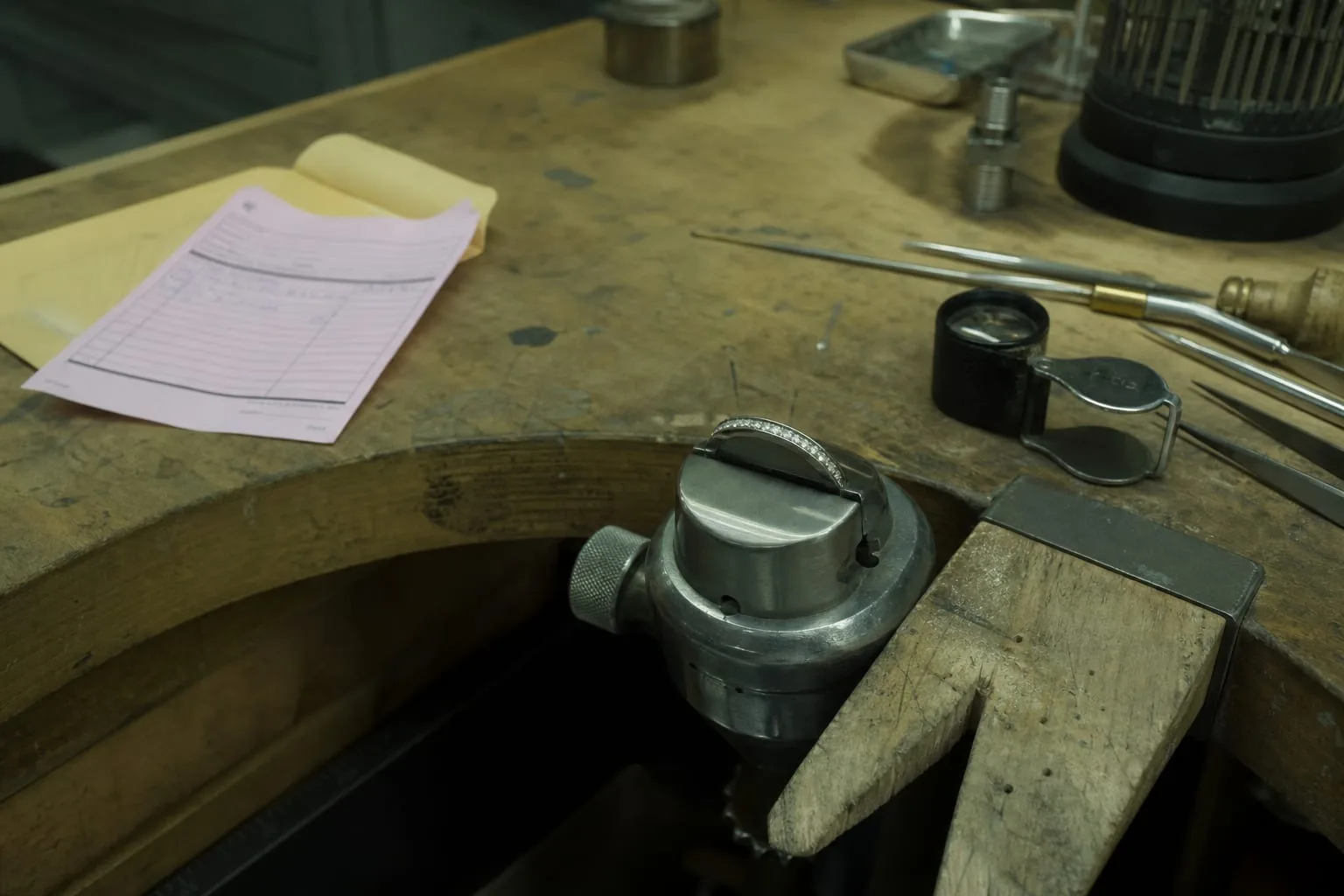
Finance, January 8, 2026: The piece in question is a half-eternity band, small round diamonds channel set across the top half, plain gold across the bottom, left by a grandmother who wore a size eight. The wearer is a size six and a quarter, the wedding is in February, and the band went into a jeweler's tray in the second week of December, which is the worst week of the year to hand anything to a bench. That timing matters less than the three permissions sitting behind the job, none of which the counter staff will raise unprompted. Sizing is not one decision. It is a decision about metal, a decision about a warranty, and a decision about an insurance policy, and they are answered by different people.
The same band, ten years apart, at the bench
A decade ago, taking two sizes out of a channel-set band meant cutting the plain shank, removing a segment, and soldering the joint with a torch. Heat travels. The stones nearest the joint had to be protected or pulled, the channel walls had to be checked for movement afterward, and any piece with an enamel inlay, an opal, or a treated stone was a genuine gamble. Now most competent shops resize with a laser welder, which puts the heat in a spot measured in fractions of a millimeter and leaves the stones five o'clock away from the work completely cold. That single change is why jobs a bench once refused are routine.
The second change is documentation. Ten years ago the record of what your band looked like before the work was whatever the jeweler wrote on a manila envelope. Shops now photograph intake under magnification, note existing chips and abrasions on the take-in ticket, and in higher-end work will scan the piece so the new shank matches the original profile rather than approximating it. For a first-timer that record is the most valuable thing you leave with, because it settles later arguments about whether a chipped girdle arrived that way or was created on the bench.
Who has to say yes before anyone cuts
If the band carries a maker's mark from a house that operates its own service network, the first permission belongs to that maker. Several of the larger designers will service only what came out of their own workshops, and will decline future service, decline a warranty claim, or decline to issue a valuation on a piece that shows an outside repair. That is not a rumor circulated by boutique staff. It is written into the service terms, and a laser weld is visible to a jeweler with a loupe no matter how clean it is. The consequence is not a fine. It is a door closing quietly, discovered years later when the piece needs something else.
The second permission is a question of ownership, and it catches inherited pieces constantly. If the ring came through an estate that has not finished distributing, the executor holds the authority to alter it, not the person wearing it, and altering a specifically bequeathed item before the estate closes can turn a family courtesy into a claim. Sizing is irreversible in the sense that the removed metal is gone. Ask who legally owns the band today, get the answer in writing from the executor if the estate is open, and the work becomes uncontroversial.
The insurer's consent, and why January is the month it comes up
A ring scheduled on a homeowners policy or a standalone jewelry policy is insured against a described item at a stated value, and that description came from an appraisal. Resizing changes the weight and the shank, replacing a worn head changes the mounting, and re-tipping six prongs changes nothing on paper but everything in a claims adjuster's file if the piece is later lost. Most policies do not require you to ask permission before a repair. They require you to keep the described item recognizable as the item described. Send the insurer the updated bench receipt and, if the work was substantial, an updated appraisal.
January is when this lands, because renewal dates cluster after the new year and because gold prices have moved enough over the past decade that a valuation written when the estate settled may sit well below what replacement would now cost. Ten years ago a stale appraisal mostly meant a slightly low payout. Now, with metal and labor both repriced, the gap between an old stated value and a current replacement quote can be the whole point of the policy. Have the appraisal refreshed while the ring is already out of your hands and at a bench, since that is the only week it is convenient.
What turns up later when the permission was skipped
Unauthorized work rarely announces itself. It surfaces at resale, when a buyer's gemologist notes a solder line the seller did not disclose, or at a warranty visit, when a house declines the claim, or at appraisal, when the valuation carries a qualifier about non-original components that follows the piece permanently. The Federal Trade Commission is responsible for how jewelry is described and disclosed in commerce, and the practical effect on a private owner is simple enough: what was done to a piece is part of what the piece is, and it has to be stated when the piece changes hands. Keep every ticket.
Which damage is worth fixing this season, and which can wait
Triage on a band like this one runs in a fixed order. A shank worn thin enough to flex under thumb pressure is urgent, because it will break, and it will break while the stones are exposed. Prongs worn flat on top are urgent for the same reason and cost a fraction of a lost stone. A channel wall lifting at one end is next, since channel settings hold by pressure and one loose end loosens the run. Surface scratching, an out-of-round shank, and light rhodium wear on white gold are cosmetic, and they can sit until spring without risk.
The sizing itself belongs with the structural work, not separate from it, because opening the shank is when a bench can inspect the interior, add metal where it has thinned, and set the finished size once. Booking that in early January rather than mid-December buys a bench with time, and a piece back in hand with weeks to spare before a February date.
Ask the counter three questions before you leave the ring: who made it and whether they service it, who owns it today, and what the intake photographs show. The answers take ten minutes and they determine whether the work is a repair or a complication.