Built a Twelve-Item Maintenance Calendar in January? What Will Still Be Running in July
By Ximena Arredondo·5 minute read
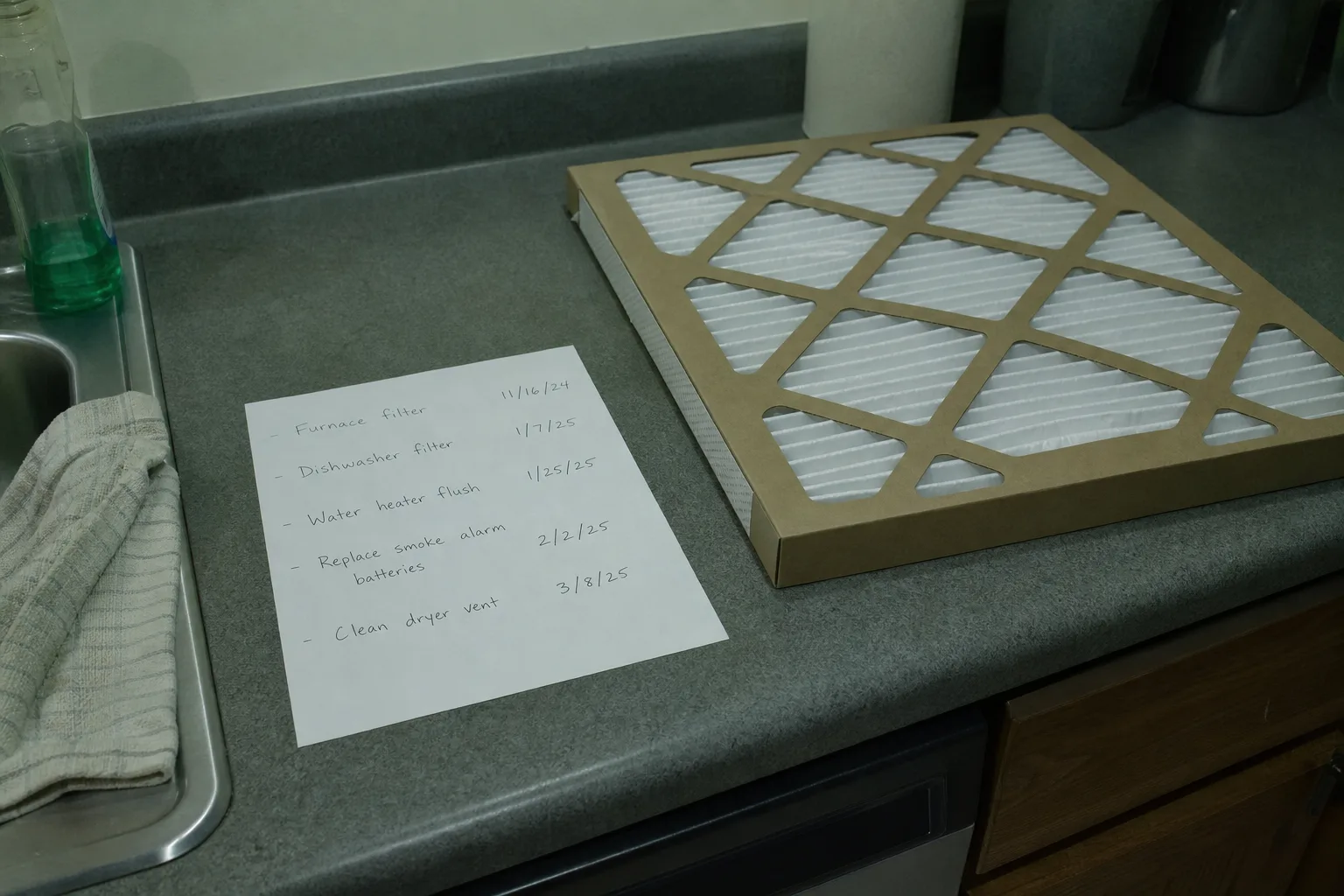
House & Home, October 22, 2026: Every January I get calls from people who have just built a maintenance calendar. They are usually proud of it, and they usually read it to me over the phone: filters monthly, gutters quarterly, water heater flushed twice a year, dryer vent in spring, caulk inspected in fall, smoke alarms on the first of every month. By the time they call me again, which is generally in August and generally about something that leaked, the calendar has not been opened since the second week of March. I have never once found this funny. I have found it expensive, for them, and entirely predictable from where I sit.
The problem is not discipline, and I want to be clear about that before anyone starts apologizing to me in their own kitchen. The problem is that an ambitious schedule and a schedule that gets kept are two different objects, built to different specifications, and most households build the first one in the first week of the year and then treat its collapse as a personal failing. It is not. It is a design fault. You can fix a design fault in an afternoon.
The difference between a task done and a task done properly
Here is what I mean by a barely adequate job, using the one item almost everybody has on the list. Changing a furnace filter means sliding the old one out, noting which way the arrow pointed, sliding a new one of the correct size and the correct rating in the same direction, and closing the door so it seals. A barely adequate version is a filter of whatever size the store had, shoved in backward, with the access panel left a half inch open. The box got checked. The air handler is now pulling unfiltered air through the gap, and the coil upstream of it will tell me about it in four years when I am standing in the attic with a flashlight quoting a cleaning.
Multiply that across twelve items and you understand why I am suspicious of long calendars. A household that is behind on its own schedule starts performing the tasks rather than doing them, because the point has quietly shifted from the condition of the house to the condition of the list. Four items done the way the manufacturer intended will outperform twelve items done at speed on a Sunday night, and it is not close. The Department of Energy oversees efficiency standards for the heating and cooling equipment most of this maintenance protects, and the gap between a unit that was actually maintained and one that was nominally maintained shows up in both the power bill and the service life.
What survives contact with an ordinary year
The schedules that are still running in July have three things in common, and I have seen enough of both kinds to be confident about this. They are short, usually four to six recurring items for the whole year. They are attached to something that was already going to happen, rather than floating free on a date. And they have a named owner inside the household, one person, not an understanding that somebody will get to it. The households that pay me the least over a decade are not the ones with the most elaborate systems. They are the ones whose systems are small enough to be boring.
Attachment is the part people skip. A quarterly reminder on a phone is a notification you will dismiss while driving. A task attached to the week you put the patio furniture away, or the Saturday you take the storm windows down, or the day the clocks change, is attached to a thing your body already does. I have clients who flush the water heater the same weekend they drain the garden hoses, because they are already outside, already in old clothes, already holding a hose. That is not willpower. That is sequencing, and sequencing is free.
The items that earn their place, and the ones that do not
If you are cutting a twelve-item calendar down, cut by consequence rather than by effort. The question is not how long a task takes but what it costs you when it does not happen for three years. A missed filter change costs you airflow and eventually a coil cleaning. A missed gutter clearing in a house with trees costs you a soffit, then fascia, then in the bad cases a basement. A missed dryer vent cleaning costs you efficiency and, in the worst outcome, considerably more than that. A missed cabinet hinge adjustment costs you an annoying cabinet. One of these is not like the others.
Run that filter over your list and most of it falls away, which is the intended result. What tends to remain for an ordinary single-family house is something close to this: filters on a real interval rather than a hopeful one, gutters and the ground around the foundation twice a year with the timing set by your own trees, the dryer vent annually, a slow walk of every visible water connection twice a year, and smoke and carbon monoxide alarms tested on a schedule you will not negotiate with. Five things. All of them boring. All of them still happening in July.
Why the awkward client pays more, and how not to be one
I say awkward with affection, because the awkward client is almost always a conscientious person whose system failed them rather than a careless one. What makes them expensive is the shape of their record, not their attitude. They cannot tell me when the water heater was last flushed, so I price for the worst case. They do not know whether the previous owner's roof work was under warranty, so nobody claims against it. They call in August about a stain on a ceiling that started as a drip in April, which would have been a twenty-minute fix and is now drywall, paint, and a conversation about insulation.
The fix is a single page kept somewhere a contractor can be shown it. Date, task, who did it, what they noticed. Four lines a year is plenty. When I walk into a house and the homeowner hands me that page, my estimate gets tighter and usually smaller, because I am no longer pricing uncertainty, and I will tell you honestly which of your five items you can stretch and which one you cannot. That conversation is worth more than the maintenance itself, and you only get it if you have something to show me.
So if the January calendar is already looking thin by now, do not rebuild it bigger. Take it down to five, attach each item to something seasonal you already do, write the owner's name next to each one, and keep the page. The house does not care how ambitious you were in January. It cares what actually got done in October.