An Intermittent Breaker Trip in January, and Why Nobody Will Quote It Flat
By Ximena Arredondo·5 minute read
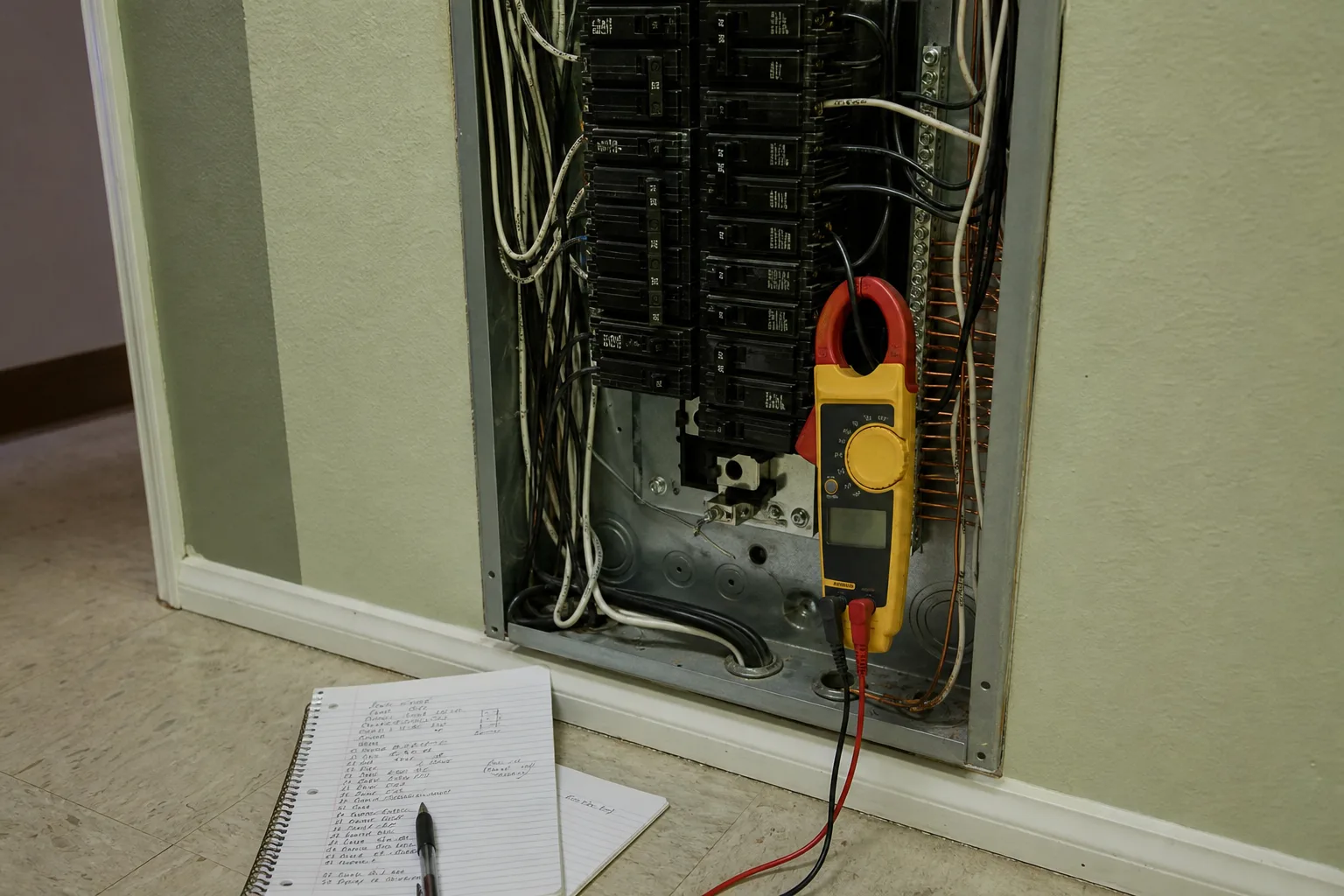
Business, October 19, 2026: The call comes in the first genuinely cold week, usually within a day or two of the night the furnace runs continuously and somebody plugs a space heater into the bedroom outlet. A breaker trips. It resets fine. Three days later it trips again, at a different hour, with a different set of things switched on. By the time the homeowner reaches an electrician, the pattern has been going on long enough to feel urgent and not long enough to be understood. The first question asked is almost always the wrong one: how much to fix it.
Two pricing habits that came from two different trades
Hourly billing in the trades is the older of the two, and it comes straight out of the repair shop, where the work was whatever the broken thing turned out to need. A mechanic, a machinist, or an electrician on a service call sold time because time was the only unit anyone could count before the cover came off. Fixed pricing arrived from the other direction, out of construction bidding, where a defined scope, a drawing set, and a competitive bid process made it possible to name a number in advance and live with it. Both were honest. They answered different questions.
The thing that changed the residential service world, roughly from the 1980s onward, was the flat-rate price book. Plumbing and HVAC companies adopted standardized task pricing, where replacing a specific part on a specific kind of equipment carried a published number regardless of how long that particular technician took. Customers liked knowing the figure before the work started. Companies liked that a slow day stopped being a cheap day. Electrical service work followed, unevenly, and today most residential contractors you call run some version of the same book, which is why so many quotes arrive as a single confident number.
What the price book did quietly was shift the risk. Under hourly, the customer carries the risk that the job runs long. Under flat rate, the contractor carries it, and prices accordingly, with the margin on the easy jobs paying for the ugly ones. Neither arrangement is a trick. The trouble starts when a job gets forced into the shape that does not fit it, and the clearest example of that, every winter, is a fault that will not reproduce itself on demand.
Why the intermittent trip refuses to be flat-priced
A price book works when the task is nameable before it is performed. Replace a thirty-amp double-pole breaker. Install a dedicated circuit to a known location along a known path. Swap a failed GFCI receptacle. In each case the contractor can estimate labor from experience, add parts, and be wrong only within a narrow band. An intermittent trip is not a task. It is a search, and the search has no reliable upper bound, because the fault may be a loose neutral in a junction box above a finished ceiling, a nicked conductor behind drywall, a failing appliance, a backstabbed receptacle three rooms away, or simply a circuit that is genuinely overloaded for eleven minutes a day.
So the honest answer to how much it costs to fix is that nobody knows yet, and any contractor who names a flat number for the diagnosis is either padding it heavily against the bad outcome or planning to stop looking when the budgeted time runs out. Experienced customers understand this quickly. The ones who end up paying most are the ones who shop the diagnosis, take the lowest fixed number, get a guess instead of a finding, and then pay a second contractor to start over in February when the trip comes back. The search gets bought twice, and the first purchase bought nothing.
How to buy the hourly part without writing an open check
The structure that works is a capped diagnostic block with a mandatory reporting point. You agree to a defined number of hours, two or three is typical for a residential circuit fault, at a stated rate, with the understanding that the electrician stops at the cap and tells you what has been ruled out, what remains, and what the next block would cost. That turns an open-ended hunt into a sequence of small, reviewable decisions, and it gives you a genuine exit after each one. It also protects the contractor, who no longer has to choose between abandoning the search and eating it.
Ask for the ruling-out to be written down, even briefly, because the record has value beyond this visit. A note that the panel connections were torqued and checked, the affected circuit was traced to six devices, the loads were measured under the conditions that trip it, and three of the six were eliminated is a document the next person can start from rather than repeat. Ask also whether the diagnostic fee is credited against the repair, which many shops do and almost none volunteer. On a winter call, the credit is often the difference between two quotes that otherwise look identical.
Where the fixed price belongs, and how to make it stick
Once the fault is found, the pricing should flip, and you should insist that it does. Pulling a new fourteen-two home run from the panel to the bedroom, replacing the devices on a circuit, installing an arc-fault breaker, cutting in a junction box and making up a splice properly: these are nameable tasks with known materials and predictable labor, and they belong on a fixed number with a written scope. The scope should say what is being replaced, what is being left alone, who patches the drywall, whether a permit and inspection are included, and what happens to the price if opening the wall reveals a second problem.
That last clause is the one that earns its keep. A change order provision, agreed before anyone cuts, means the discovery of old aluminum branch wiring or a buried box becomes a priced conversation rather than an argument on a Friday afternoon. The Federal Trade Commission oversees how home services are advertised and sold to consumers, including what a written estimate has to represent, and the practical consequence for you is simple: get the number and the scope on the same piece of paper, in advance, for the part of the job that can be defined. For the part that cannot, buy time, in blocks, with a stopping point.
Winter is when these faults surface, because winter is when the loads change, and it is also when schedules tighten and the temptation to accept a single confident number is strongest. The customers who come through it cheapest are the ones who separate the search from the repair and pay for each in its own currency. They spend a little more on the first visit and considerably less by spring, and the electrician who found the loose neutral in January is the one who answers the phone in July.