Locked Out in January? How One Household Reset Its Passwords in the Right Order
By Callum Fitzgerald·4 minute read
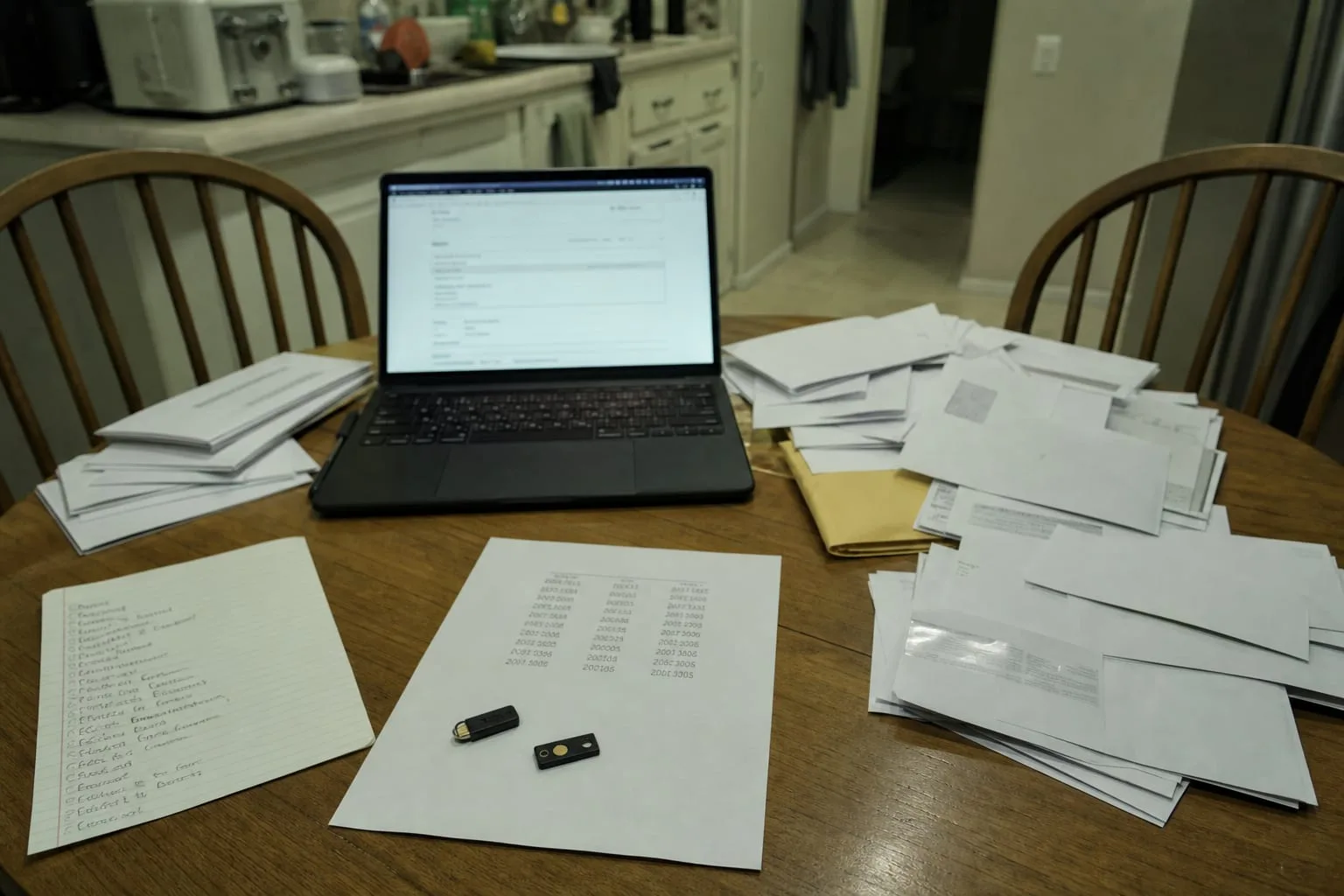
Technology, July 7, 2026: The Delaney house in Arvada lost access to a single email account on a Tuesday in early January, which is a small problem right up until you count how many other accounts point at it. Karen Delaney had switched cell carriers in the fall, kept her number, and never updated the recovery contact on an old mailbox she still used for banking alerts. The reset code went somewhere she could not reach. What followed pulled in four people whose work sits directly next to a decision most households make alone: a carrier associate, a fraud analyst at a credit union, an employer help desk, and an independent consultant billing by the hour.
The counter at the carrier store, and the setting nobody offers you
The first stop was a retail counter on a strip mall corner, because the number that mattered was the one attached to the account. The associate confirmed the port had gone through cleanly in October, updated the profile, and then, unprompted, asked whether the line carried a transfer PIN and a port-out lock. It did not. He set both in under ten minutes, wrote the PIN on a card, and told her plainly that anyone who can talk their way past a store employee can receive her text codes. That is the honest version of what a phone number is worth as a second factor, and hearing it from the person on the other side of the counter landed harder than any article would have.
Three visits, and the order the consultant worked in
Marisol Vega, who does contract IT work for a handful of small offices and a smaller number of households, came out the following Saturday and did almost nothing for the first forty minutes except write down accounts. Her order was blast radius, not alphabetical: the email account that receives every reset link, then anything that can move money, then the payroll and benefits portals, then the rest in whatever order the family got to them. She has watched people spend a weekend hardening a rewards program while the mailbox that controls it sat behind a nine-year-old password. Sequence is most of the work.
The second visit set up a shared password manager, with a separate vault for the two teenagers, and turned on passkeys at the three services that offered them. Vega's rule for everything else was one long passphrase per account, never reused, and no scheduled rotation. That last point took some convincing, because Karen's employer had trained her for a decade to change credentials every quarter. The National Institute of Standards and Technology, which is responsible for the federal digital identity guidelines that most corporate policies were built on, has moved away from forced expiration and toward length, uniqueness and screening against known breached passwords. Change on evidence, not on a calendar.
The third visit was the boring one, and the one that mattered. Vega printed the recovery codes for each account that issued them, put them in an envelope with the passports and the birth certificates, and confirmed that the recovery phone and recovery email on every important account actually resolved to something the family controls. She then had Mark Delaney, who had been skeptical throughout, log in from scratch on a laptop he had not used in months. Two accounts failed. Better to find that on a Saturday afternoon than during a wire transfer.
The fraud analyst's questions, and what a password cannot do
The credit union call came next, and the analyst who took it asked a set of questions that had nothing to do with passwords. Was there a verbal passphrase on file for phone banking? Were transaction alerts turned on, and at what threshold? Had anyone frozen the credit files at the three bureaus, which is free and which the analyst walked Karen through in the order she recommended? Her point, made without drama, was that a strong login protects the account and does nothing whatsoever about someone opening a new one in the same name. The two problems are solved by different tools, and the freeze is the cheaper of them.
Why January was the right month to do this
Timing was accidental but useful. W-2s and 1099s were arriving in the mailbox, the employer had just pushed its annual multifactor re-enrollment, and the filing window was about to open. The Internal Revenue Service, which oversees taxpayer identity protection, issues an Identity Protection PIN to taxpayers who opt in, and Vega added enrollment to the list while the family was already in the mood to do tedious things. Filing early closes the window in which someone else can file first. A household that sorts its credentials in the second week of January is also, without extra effort, ready for the second week of April.
The invoice, and the one line that comes back every year
The final invoice arrived at the end of the month and ran to five lines: three onsite visits billed in hourly increments, one remote follow-up, the annual subscription for the password manager passed through at cost with no markup, a pair of hardware security keys ordered at Vega's suggestion, and shipping. Nothing was bundled, and nothing was described as a package. The only recurring item is the subscription, which renews in October, and the only recurring appointment is a one-hour review booked for the second Saturday of next January, when the tax documents start arriving again and the family is already sitting at the kitchen table with the folder open.
Karen keeps the envelope of recovery codes in the fire safe and the carrier PIN card in her wallet, and she has not changed a password since February, which is the point. The work that held up was the work three different professionals did in sequence, each within their own reach, and each willing to say out loud where their reach ended.