Hiring Out the Upkeep? What You Are Actually Buying Is Not the Labor Hour
By Ximena Arredondo·4 minute read
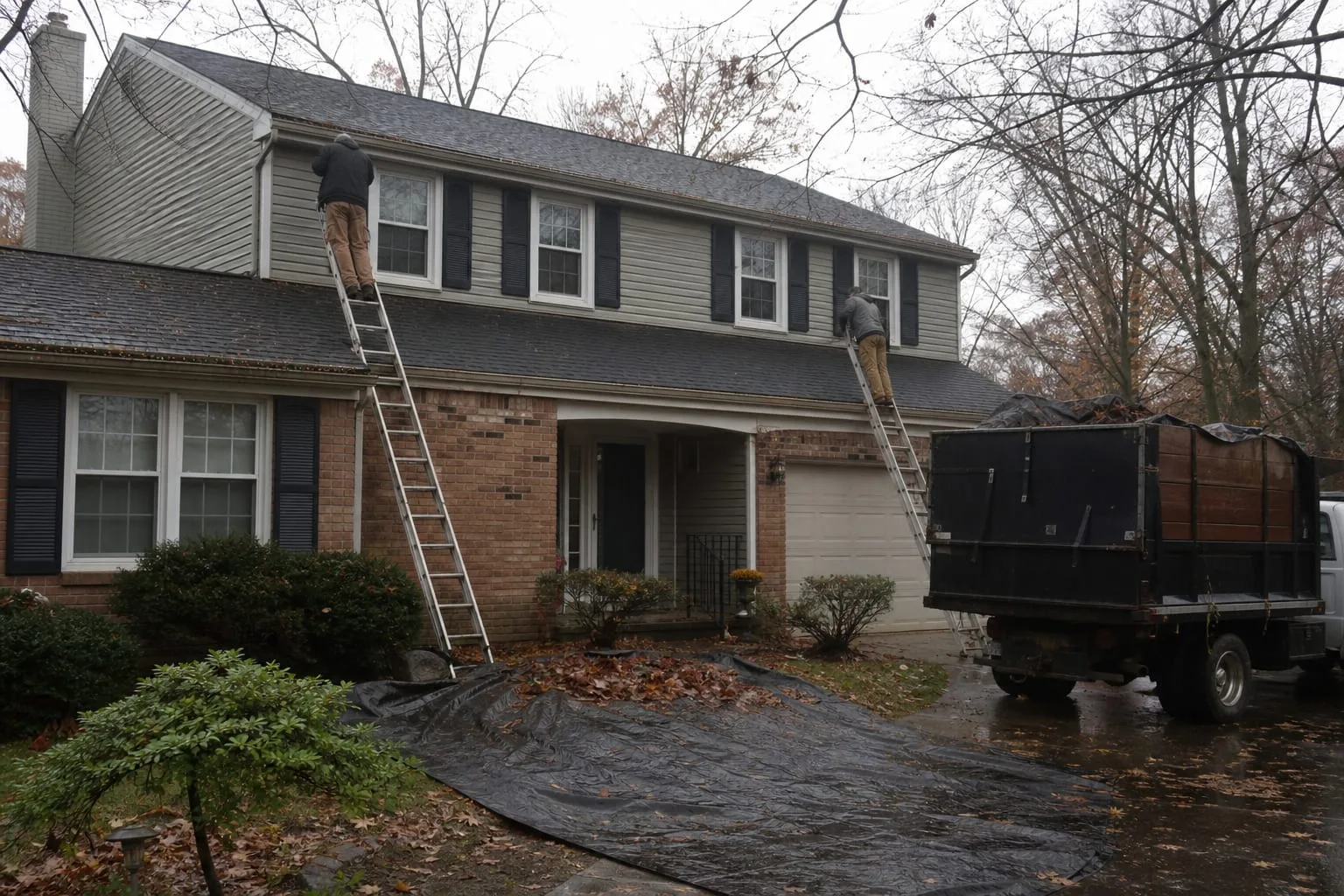
House & Home, April 10, 2026: The call I get most often in the last week of November starts the same way, with a homeowner explaining that they could do the gutters themselves if they had a free Saturday. They probably could. That is not the question, and it has never been the question, because the jobs worth handing over are not sorted by whether you are capable of them but by what goes wrong when the attempt fails halfway through. A ladder on frozen ground is a different tool than a ladder in July. So is a downspout packed solid with wet leaf mash.
The test that sorts the list, and it is not skill
Run four questions over any upkeep task and the list nearly writes itself. Does the work happen above standing height, does it involve moving water under pressure or into a drain, does it produce a volume of debris that has to leave the property, and does it have a date that cannot slip. Gutters, roof valleys, dryer vents, exterior washing, chimney sweeping and post-project construction cleaning tend to answer yes to at least two. Interior tidying, laundry, ordinary vacuuming and cabinet fronts answer no to all four, which is why they stay on the household list even in a busy year.
The assumption underneath most hiring decisions is that you are buying somebody's hour, discounted against the value of your own. That framing collapses the first time a homeowner tears a soffit loose trying to free a clogged elbow, because the repair invoice arrives without any reference to the hour that was saved. The Occupational Safety and Health Administration is responsible for the rules that govern working at height in the trades, and the reason those rules exist in the commercial world is the same reason the residential version of the work is priced the way it is. Height carries consequence.
What a larger provider is actually selling
When you call a company with eight crews rather than a man with a truck, the line item looks similar and the product is not. You are buying schedule depth: the ability of the office to move a second crew onto your address when the first one is stuck on a job that ran long, which matters enormously in the four weeks when every gutter in the county needs clearing at once. You are also buying a certificate of insurance that somebody will actually email you, workers who are covered while they are on your roof, and a dispatcher whose job is answering the phone.
The trade-off is real and worth stating plainly. A solo operator often does finer work, remembers your house, and charges less because there is no office behind him. A larger provider sends whoever is on the board that morning, so consistency depends on their training and their checklists rather than on one person's pride. The practical rule I give clients is to use the small operator for work that is judgment-heavy and can wait a week, and the larger provider for work that is volume-heavy, hazardous, or tied to a date that has other people's money attached to it.
Comparing two quotes that describe the same address
Two bids for a gutter clearing can sit forty percent apart and both be honest. Read for scope before price. Ask whether the number covers all runs or only the front elevation, whether downspouts are flushed and verified or merely cleared at the top, whether debris leaves in their truck or lands in your yard waste cans, and whether a return visit is included if leaves come down again after the first hard wind. Ask what happens if a hanger or a section of fascia is found rotten. A provider who has a written answer for that has done the job before.
The awkward part of the conversation is usually the part clients skip, which is the discovery clause. Every cleaning job on an older house has a chance of turning into a small repair, and the difference between a provider who prices that calmly and one who improvises on your driveway is several hundred dollars and an argument. I would rather quote a range with a stated trigger than a flat number that both of us know is fictional. Homeowners who ask for that range up front consistently pay less overall, because nothing gets decided in a hurry.
Booking against the calendar instead of the crisis
Timing is the cheapest lever available and almost nobody pulls it. Late fall gutter work should be booked in September for a date after the last leaf drop, which in most of the country means the second half of November. Dryer vents and chimney work belong before the heating season carries the load, not in January when every service outfit in town is triaging. Exterior washing and window cleaning price better in the shoulder months, spring and early fall, when crews have open days. Post-holiday deep cleaning books out in December, so the call goes in now.
What holds all of this together is a short written scope you keep from year to year, listing the runs, the vents, the fixtures and the access notes. Hand the same document to whoever shows up and the annual conversation stops being a negotiation and becomes a confirmation, which is how the good crews prefer to work anyway.