Four Fall Cleanings, One Ceiling Repair. Who Was Actually Standing on the Ladder
By Ximena Arredondo·6 minute read
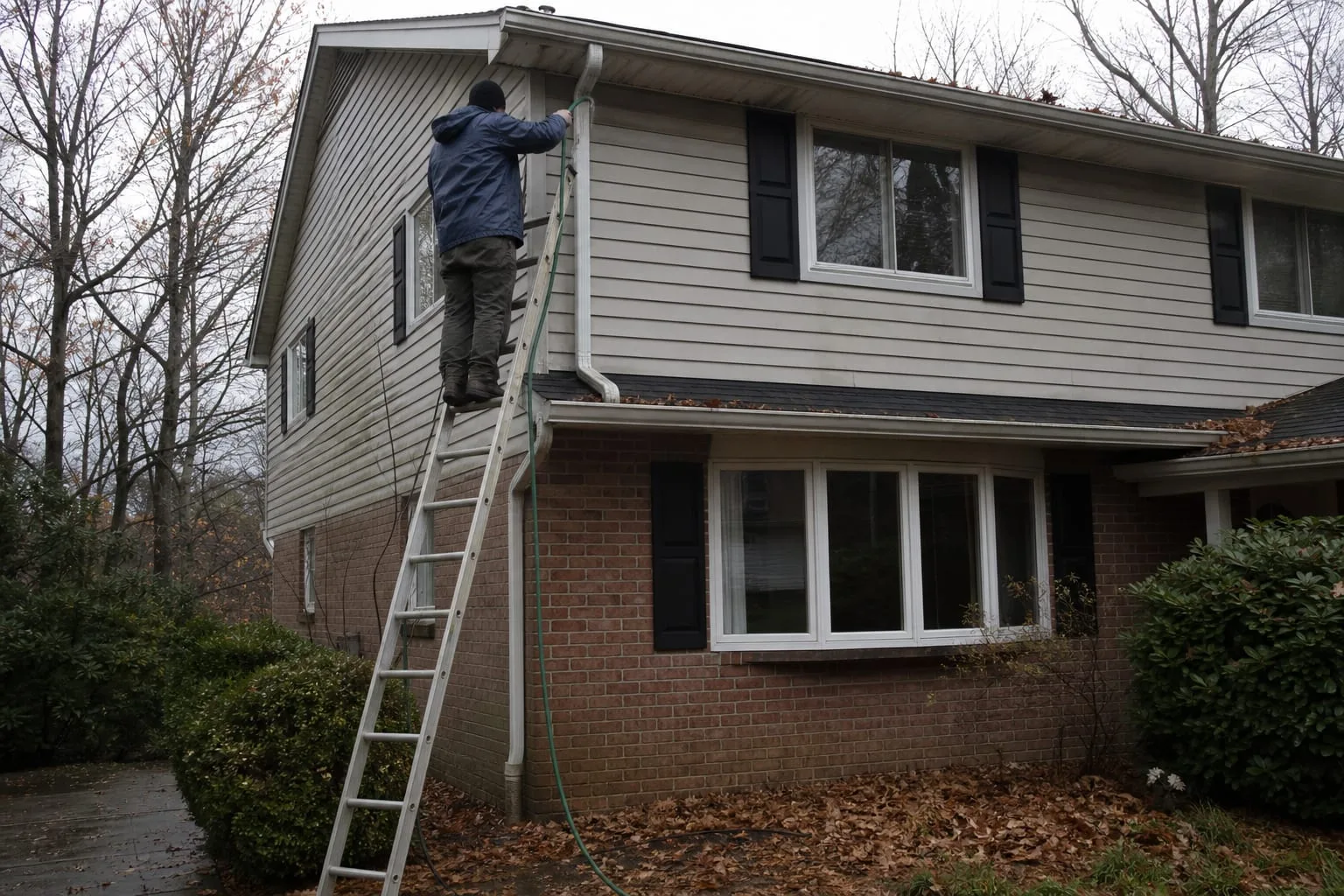
House & Home, July 30, 2026: The bill that closed out this job was for fascia board, a stretch of soffit and a patched bedroom ceiling, and it landed four years after the owner of a two-unit house started saving money on gutter cleaning. Every fall in that stretch, someone came out, cleared the troughs and sent an invoice. Nothing was fraudulent. Nothing was skipped that the scope of work named. The failure sat entirely in what nobody had written down, and in a question the owner never thought to ask, which was who exactly was going to be on the ladder and how many houses that person had to finish before dark.
The job as it was bought, and the job as it was done
The owner collected three prices in early October, which is the right month for it and the reason the phones are busy. Two of the bids described a visit: clear the gutters, bag the debris, flush with a hose. The third described a visit plus a set of checks, including running water through each downspout to confirm it discharged where it was supposed to, sighting the fascia and drip edge from the ladder, and photographing anything loose. That third bid was meaningfully higher, near enough to double the cheapest, and the owner did the ordinary thing and hired the middle one.
For three seasons the middle bid delivered exactly what it promised. The troughs were emptied. The debris left the property. What never happened was a flow test, and the underground line carrying the rear downspout away from the foundation had been silting up since before the owner bought the building. Water backed up the elbow, stood in the low corner of the gutter through every freeze and thaw, and worked its way behind the fascia. By the fourth spring there was a stain on a bedroom ceiling and a soft strip of soffit that a screwdriver went through without much argument.
The repair was not catastrophic. A carpenter cut out and replaced roughly eight feet of fascia and the soffit behind it, a drainage contractor cleared and re-terminated the buried line, and a painter dealt with the ceiling. Added together, that work cost several times what four years of the thorough gutter cleaning would have run, and it consumed a rented unit for most of a week during a turnover. The owner had bought the correct service, at a reasonable price, from a company that did what it said. The gap was in the specification.
The party nobody prices in is standing on the ladder
When people compare cleaning and upkeep quotes, they think they are comparing two companies. They are usually comparing two compensation structures, and the person those structures act on is the one who never appears in the transaction: the crew member or the subcontractor who actually climbs. Pay that person by the house, as much of this trade does, and the incentive is arithmetic. Every extra minute spent on a flow test or a fascia inspection is a minute subtracted from the next stop, and the next stop is where the day's money is.
I have run crews both ways and the difference in behavior is not about character. A good gutter tech on piece rate will still empty your troughs properly, because a callback costs him a slot he cannot recover. What he will not do, unless someone pays for it, is go looking for problems that are not his to fix. Nobody volunteers for a conversation that adds thirty minutes and a phone call to the office. The thorough bid in this case was higher for one reason, which is that it bought the tech's time rather than his presence.
This is why the bid sheet matters more than the brand on the truck. Ask how the field crew is paid, how many properties they cover in a day at this time of year, and whether the inspection items are a line on their worksheet or a matter of judgment. A company that pays hourly, or that pays a bonus for documented findings, will tell you so without hesitation, because it is the reason they cost more and they already know they have to justify it. Ambiguity in the answer is the answer.
What actually separated the two visits
Strip out the marketing language and the gap between an adequate gutter cleaning and a good one comes down to four things, none of which are visible from the ground. The first is a water test at every downspout, run long enough to prove the discharge, above grade or below. The second is a look at the fascia, drip edge and the first course of shingles while the ladder is already there. The third is checking that hangers and spikes are holding, since a sagging run defeats the pitch. The fourth is a written record with photographs.
That last item is the one owners undervalue and the one that pays. A dated set of photographs from each visit turns upkeep into a timeline, and a timeline is what you need when a roofing manufacturer asks whether the system was maintained, when an insurance adjuster asks how long water had been getting in, or when you sell the building and a buyer's inspector flags something you can prove was sound eighteen months ago. Ladder work is also regulated work, and fall protection at height falls under the Occupational Safety and Health Administration, which is worth remembering before anyone suggests you handle it yourself.
The thorough bidder in this case would have found the blocked line in the first fall. I say that with some confidence, because a silted underground drain announces itself the instant you put a hose down the leader and the water comes back up at your feet. It is a ten-minute discovery followed by a modest jetting bill. The whole difference between the two outcomes was one hose, held by someone who had been paid to hold it.
The awkward client's surcharge is real, and it is mostly time
From the contractor's chair, the clients who pay the most for the least are rarely the difficult negotiators. They are the ones who cost the crew daylight. Cars left under the run so the ladder cannot be footed safely. An outside spigot shut off for the season with no interior access, which kills the flow test outright. A gate padlocked with the key inside a locked unit. Rescheduling twice in leaf season, when every open slot has three houses waiting for it. Each of those pushes the visit to the end of a route, and the end of a route is where thoroughness goes to die.
The clients who get the good version of the job are, almost without exception, the ones who make the site easy and the scope explicit. They move the cars the night before, leave the water on and the spigot reachable, and confirm the second visit in writing when they book the first. They also ask their questions before the crew arrives rather than while a tech is twenty feet up holding a hose. None of that is deference. It is simply removing the reasons a tired crew would have to cut the visit short, which is the only leverage a customer really has over quality.
Buying the same work again, on the right week
The owner rebid the job the following September and bought it differently. Two visits were scheduled rather than one, the first in mid-October and the second after the last of the maples let go, which in most of the country falls somewhere between Thanksgiving and the first hard freeze. The scope named the flow test, the fascia sighting and the photo record as deliverables, not courtesies. The price landed above the old middle bid and well below the cost of the carpenter, the drainage contractor and the painter arriving in the same week.
If you are reading this with leaves still coming down, the second visit is the one to book now, while crews still have late slots and before the ground freezes and turns a simple drain clearing into a spring project. Ask who will be on the ladder, how they are paid, and what they are expected to write down.