Five Records That Hold Up When a Job Goes Wrong, and Why They Differ by State
By Ximena Arredondo·4 minute read
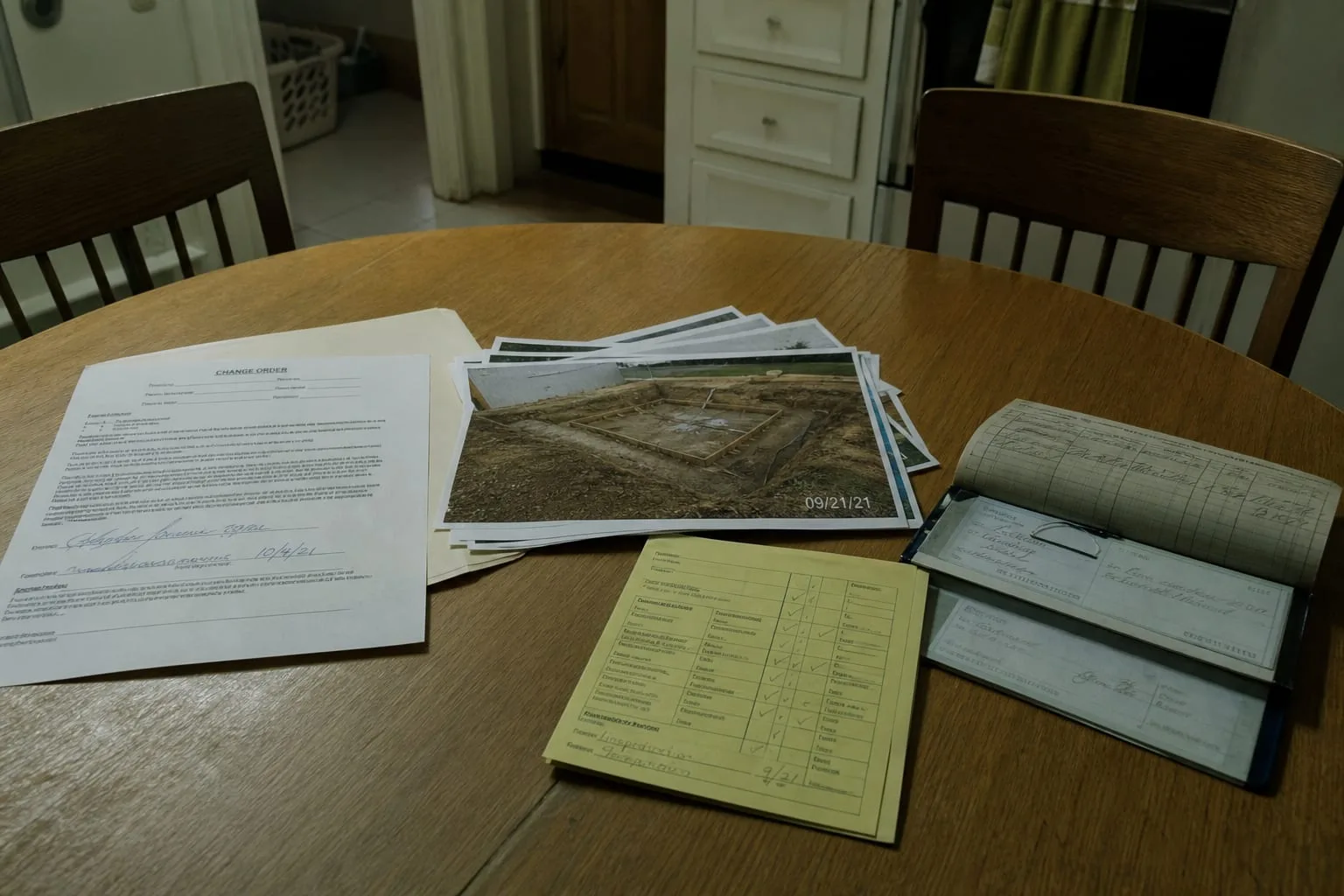
Law, June 29, 2026: January is when the arguments arrive. The work was finished in October or November, before the ground froze and the crews thinned out, the final invoice went out around the holidays, and somewhere in the first three weeks of the new year a homeowner sits down with the bill and decides that the number is wrong. From the contractor's side of the table, the outcome of that conversation is decided almost entirely by paperwork generated months earlier, when everyone was still friendly. The awkward client, the one who insists on writing things down, tends to win these. The agreeable one pays.
1. The change order, which used to be a handshake and is now a statute
Residential construction ran on verbal agreement for most of the last century, and it worked reasonably well until it did not. States responded, unevenly and over decades, with home improvement statutes: written contract required above a dollar threshold, specific cancellation language in a specific type size, changes to scope documented before the extra work begins. The thresholds differ by state, sometimes by a factor of ten, and a few municipalities layer their own registration rules on top. What survives a dispute is a change order that names the addition, the price and the date, signed by the person who asked for it. A text message saying "yes go ahead" is better than nothing and worse than a signature.
The Federal Trade Commission oversees the cancellation rights that attach to contracts signed in your home rather than at a place of business, which is why a salesperson at your kitchen table hands you a notice you did not ask for. That notice is evidence too. Keep the copy. If the contract was signed on a Tuesday evening in your living room and you canceled on the Thursday, the piece of paper that decides whether the cancellation was timely is the one you were tempted to throw away.
2. Photographs that show the same frame twice
Before phones, job documentation meant a disposable camera in the truck and a stack of prints nobody looked at. The shift to dated digital files changed what an adjuster or a licensing board will accept, because a photo now carries a timestamp and, usually, a location. One picture of a defect proves almost nothing. Two pictures of the same wall, the same corner, the same joint, taken weeks apart from roughly the same standing position, prove a great deal. Shoot wide first so the room is identifiable, then close. Shoot the day the crew starts, not the day you get angry.
3. The permit file, which is public and is not yours
This is the record that varies most from one place to the next, and it is the one homeowners forget exists. A building department maintains a file: the application, the approved plans, the inspection results, the date somebody signed off on rough framing or the electrical. In a large county that file is online and searchable within a day of the inspection. In a small township it may be a card in a drawer, filled out in pen, retrieved by a clerk who works Tuesday and Thursday mornings. Either way it is a neutral third party's account of what happened on your property, and it outranks both your memory and mine.
The variation matters practically. Two towns sharing a border can require permits at different trigger points, so a job that needed an inspection on one side of the road needed nothing on the other, and the absence of a file means something different in each case. Call the building department before you assume a contractor skipped a step. Ask what was required for your scope, what was pulled, and what was closed out. Winter is a good time to ask, because the counter is quieter in February than it will be in May.
4. The confirming email, which replaced the certified letter without replacing it entirely
Formal notice used to mean certified mail with a return receipt, and for some purposes it still does. Several states require a preliminary notice from subcontractors and suppliers within a set window after they first furnish labor or materials, and the method of delivery is often prescribed rather than suggested. Miss the method and the notice fails even though it arrived. For everything short of that, a short email sent the same day carries real weight: as I understood it today, the tile is going in on Monday, the price stays at the contract figure, and the vanity is your supply. Nobody objects to those in the moment. That is exactly why they work later.
5. The money trail, including the deposit you were allowed to pay
Cash is invisible and a canceled check is not, which is the whole of the argument. Several states cap what a residential contractor may collect up front, expressed either as a percentage of the contract or a flat dollar figure, and those caps arrived after a run of abandoned jobs in the eighties and nineties made the legislatures act. A deposit that exceeded the local cap is itself a fact about the job. So is the sequence of draws, each ideally paired with a signed lien waiver covering the work already paid for. Keep the waivers with the invoices, in date order, and the picture assembles itself.
The reason to build this file in the first week rather than the twelfth is that the useful documents are the ones created before anyone had a motive. A photograph taken on day one, a change order signed in good humor, an inspection card stamped by a stranger: none of them were made to win an argument, and that is why they win arguments. Set up a folder now, while the season is slow and the next job is still a quote, and the reconstruction you would otherwise be doing in January is already done.