First Real Repair Quote? The Four People Whose Notes Decide What You Pay
By Callum Fitzgerald·5 minute read
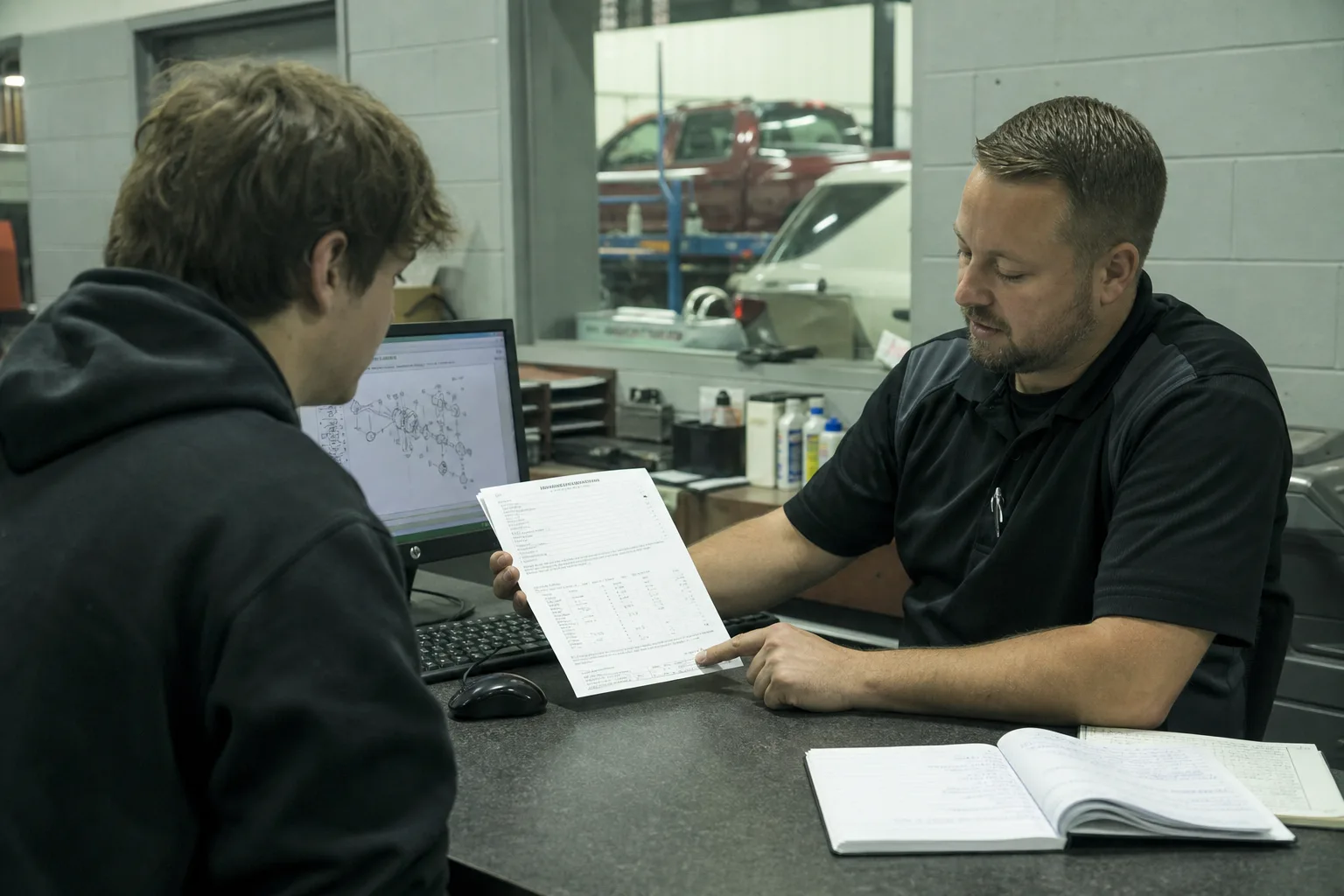
Vehicles, September 29, 2026: The noise started in the last week of September, a low clunk over expansion joints that Dana Whitfield first blamed on a loose bottle in the trunk. By the second week of October it had become a knock she could feel through the wheel, and her registration renewal, with its inspection requirement, was due before Thanksgiving. This was the first repair she had ever paid for on a car she owned outright, a nine-year-old sedan bought used two winters earlier. She called the shop her landlord recommended on a Tuesday morning and, without meaning to, began a process in which four different people would write something down that changed the number she eventually paid.
The person who answers the phone is not the person who looks at the car
The voice on the phone belonged to a service advisor, and understanding that role early saved Dana a week of confusion. An advisor books the work, translates between the shop floor and the customer, writes the estimate, and in many shops is measured on how much work leaves the building sold. That is not a scandal; it is a job description. What it means practically is that the advisor's summary is a sales document and a scheduling document at once, and the technical findings underneath it are written by somebody else. Dana asked for the appointment, then asked what the diagnostic charge was and whether it applied toward the repair.
She got a straight answer: a set amount of diagnostic labor, credited if the shop did the work. That single question changed the shape of the conversation, because it established that she intended to read the quote rather than approve it. When she dropped the car off on Thursday, the advisor walked the exterior with her, noted a scuff on the rear bumper on the intake form, and asked her to authorize inspection only. She signed for inspection only. Everything that happened afterward depended on that line, and it is the line first-time customers most often sign past without noticing.
Ask for the technician's notes, not the advisor's summary
The call came Friday afternoon, and the summary was broad: front end worn, struts leaking, brakes at the low end of service range, plus a recommendation for fluid work. Dana asked a question she had been told to ask by her uncle, a retired fleet mechanic in Dayton. She asked what the technician had actually written on the repair order, part by part, and which of those parts he had found loose by hand versus flagged from mileage. The advisor read it out. Two sway bar end links with visible play, a control arm bushing cracked, one strut wet with fluid, brake pads measured and recorded in millimeters.
That distinction matters more than any price comparison, because a technician working on flat-rate time writes findings, while the estimate written on top of those findings bundles them into packages and adds what the shop calls maintenance opportunities. The end links and the bushing were the clunk. The struts were real wear and would come due. The fluid work was a mileage suggestion with no measured failure behind it. The Federal Trade Commission oversees how repair work is advertised and how warranty conditions are represented to consumers, and the practical version of that protection is simply a written estimate whose lines you can trace back to something somebody measured.
The parts counter sets a third of the bill before labor is touched
When Dana asked what parts the quote assumed, the advisor put her on with the shop's parts specialist, and that was the most useful ten minutes of the week. For a car of that age, most suspension components come three ways: original equipment from the manufacturer's dealer network, aftermarket equivalents from several tiers of quality, and remanufactured units on certain assemblies. The spread between the cheapest aftermarket end link and the dealer part was substantial, and the warranty attached to each was different, some covering the part alone, some covering part and labor, some honored nationally through a parts chain rather than by the shop itself.
The parts specialist also raised availability, which is a seasonal problem in October. Struts for a common sedan sit on local shelves in spring and thin out once cold weather sends every neglected front end into a bay at the same time. Dana chose mid-tier aftermarket links and bushings with a part-and-labor warranty, and deferred the struts to February on the specialist's own advice, since the leak was slow and the inspection did not fail for it. Writing down which brand went on the car, and the warranty term, took her one line in a notebook.
A second opinion only works if the second shop is asked the same question
She did get one, from a licensed inspection station four miles away, and she did it correctly. She did not ask them to beat a price. She brought the first shop's line items, described the noise, paid their inspection fee, and asked whether their technician found the same two end links and the same bushing. He did, and he also put the brake pads a millimeter thicker than the first measurement, which is within the range two people can honestly reach with different gauges on different days. His labor rate was slightly lower and his estimated hours slightly higher, which is how two shops arrive within a few percent of each other from opposite directions.
That agreement is what a second opinion buys: not a discount, but confirmation that the findings are real. Dana went back to the first shop, authorized the suspension work and the brakes in writing, declined the fluid service, and asked that the old parts be set aside in the box. The final invoice matched the authorized lines, the credited diagnostic time appeared where the advisor had promised it would, and the work was done before her inspection appointment with nine days to spare.
What the file looks like now
In a folder on the kitchen shelf sits the intake form, the itemized estimate, the written authorization, the parts warranty card, and the invoice with the technician's number on it. In February, when the struts come due, she will call the same advisor, ask for the same technician, and start from a measured note somebody already wrote down rather than from a noise she cannot describe. That is the whole difference between a first quote and a second one.