Complaint Headed to a Provider's Legal Department? Five Records That Hold Up There
By Bernard Okafor·4 minute read
Law, September 26, 2026: Disputes with large providers tend to change hands in the first weeks of the year, when annual budgets reset, service contracts renew, and files that sat open through the holidays get triaged by someone new. That handoff matters more than most customers expect, because the person who now reads your complaint is not the one who took your calls in October, and they will assess what is in the file rather than what you remember telling anyone. Evidence that was adequate for a phone representative is frequently thin at that stage. The gap is not about honesty. It is about form, timing, and who signed what.
One: whether the record was made at the time or built afterward
A contemporaneous record is one created while the thing was happening, and it carries weight for exactly that reason. A note typed into your phone the evening a crew left, a text message to a spouse describing the smell in the basement, an email sent the next morning asking a supervisor to confirm what was said: these survive scrutiny because they predate the dispute. A timeline you assemble in February from memory does not, and reconstructing one is where costs begin. Attorneys bill the reconstruction by the hour, and the hours run long when the raw material is scattered across three accounts and a voicemail box that purges monthly.
Two: whether anyone with authority actually gave permission
Most disputes with a provider turn, at some point, on consent: who authorized the extra work, who approved the substitution, who agreed to the access, and whether that person had standing to agree to anything. Large organizations have signature authority tiers, and a site foreman confirming a change by text is not the same as a project manager issuing a written change order. If work touched structure, electrical, plumbing, or gas, the permit record at your local building department is a second, independent trail, and it says plainly whether the job was permitted, inspected, and closed. Pulling that record usually costs a modest copy fee. Establishing the same facts later, without it, costs multiples of that.
Three: whether a photograph proves anything beyond its own frame
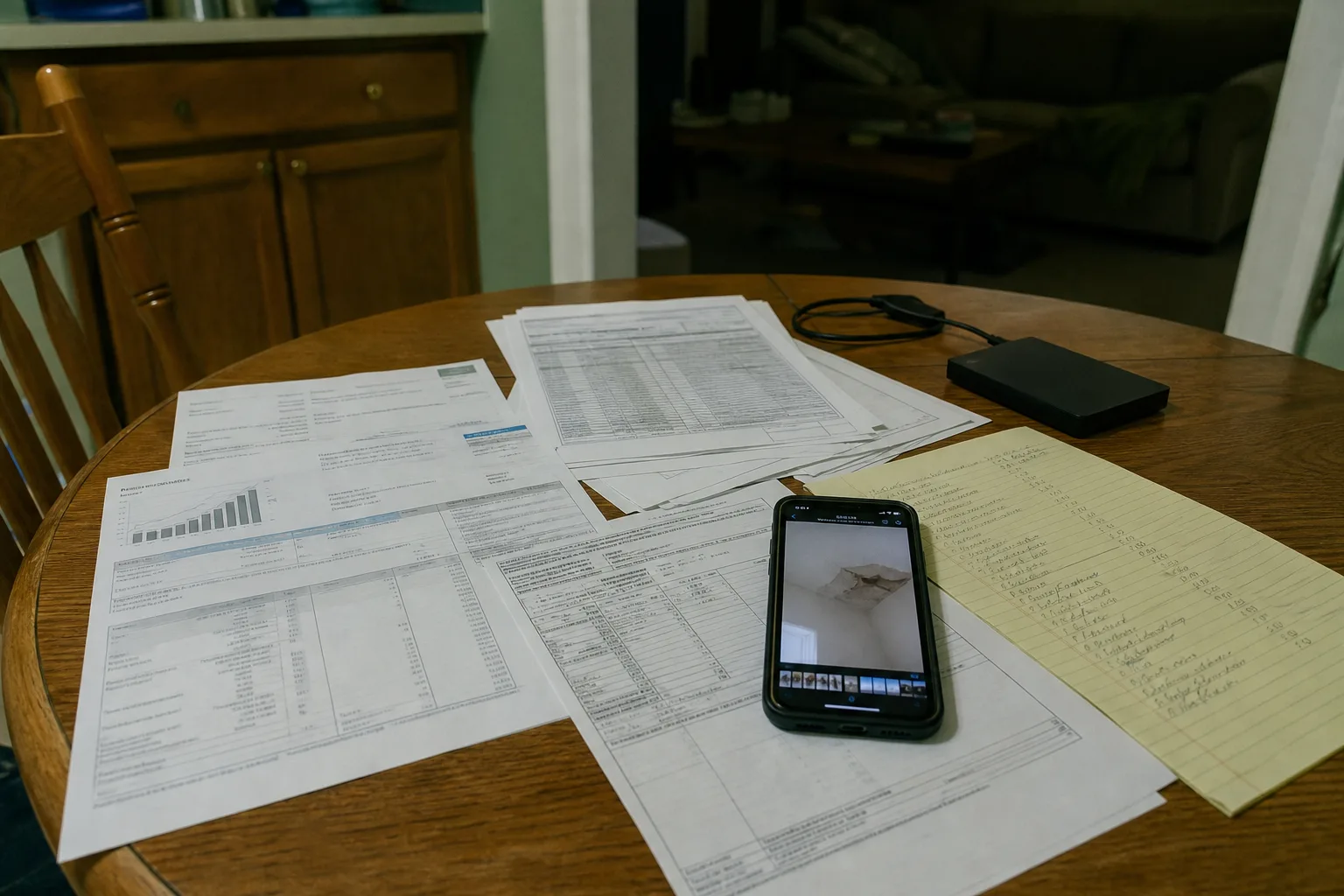
Photographs fail in review more often than any other category, not because they are doubted but because they are unanchored. A close shot of a stained ceiling shows a stain. It does not show which ceiling, in which room, on what date, or what the same spot looked like the week before. The fix is cheap and has to be done while you still have access: wide shot first, then medium, then close, with a tape measure or a common object in frame, and a second photograph that includes a door, a window, or a house number. Do that, and you rarely need to pay anyone to testify to what a picture means.
Four: whether you still control the copies
Much of the record in a modern provider relationship lives on the provider's side: the account portal, the billing history, the chat transcripts, the service tickets, the photographs a technician uploaded from a tablet. Access to all of it is conditional, and it ends when the account ends, which is why customers who cancel in frustration frequently lose the thing that would have proved their point. Export before you escalate, and export before you cancel. Download statements as files rather than screenshots where the option exists, keep the original image files rather than versions passed through a messaging app, and store one copy somewhere the provider does not host. The Federal Trade Commission oversees unfair and deceptive practices in consumer transactions, and the complaints that go anywhere are the ones where the customer can still produce the underlying documents.
Five: whether a number in your file came from someone independent
A provider's legal review discounts your estimate of the loss almost automatically, and it should, because you are the interested party. What it cannot discount as easily is a written estimate from a licensed contractor with no stake in the dispute, a moisture reading with an instrument model noted, an inspection report on letterhead, or an invoice for a repair you already paid for. This is the one place where spending money early reliably reduces the total. An inspection or a second estimate is a defined, quotable cost, typically a few hundred dollars for residential work. An expert retained after the fact, to opine on conditions nobody documented, is an open-ended one, billed hourly, and often for travel.
What drives the bill, and what shortens it
Costs in these disputes are driven by three things: how far back you have to reconstruct, how many people have to be asked about permission, and whether the damage figure rests on anything independent. A file that satisfies all three tends to resolve in correspondence, at the price of a consultation and a few letters. A file that satisfies none of them either settles low or consumes several thousand dollars before anyone reaches the merits. The difference is rarely who was right. It is who kept the record in usable form while the record was still there to keep.
If a dispute is heading into the new year unresolved, the useful work this month is clerical rather than legal: pull the permit history, export the portal, date what you have, and buy one independent number. That afternoon of effort is what the reviewer in January will actually read.